 Adam Yeo
A script you cannot type is a script at risk
When people ask me why I design typefaces for African scripts, I often answer with a simple test: try to write a message in your own script on your phone. If you cannot, your script is already losing ground — not because people stopped caring about it, but because the tools they use every day do not know it exists.
A script born on paper
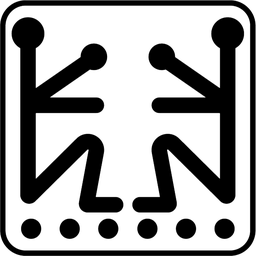
The Bété syllabary was created in Côte d'Ivoire by the artist Frédéric Bruly Bouabré in the mid-twentieth century. Each sign stands for a syllable, and many of them come from drawings of everyday things. It is at the same time a writing system and a body of images — which is exactly what first drew me to it as a designer and painter.
For decades the script lived mostly on paper: in Bouabré's notebooks, in drawings shown in museums around the world, in the hands of a small circle of people who learned it. Admired, yes. Used daily, rarely.
Three conditions for a living script
For a script to be used today, three things must exist together. First, a standard: the characters must be encoded in Unicode, so that every phone and computer agrees that a given sign is the same character. Second, a typeface: a well-drawn font that can display those characters clearly, at small sizes, on screens. Third, a community of use: schools, artists, families and institutions who actually write with it.
Missing any one of the three, the script stays in the archive. This is why my work on Bété has moved between the drawing table and technical committees: from my research at the Atelier National de Recherche Typographique in Nancy, to the working document submitted to the Unicode Technical Committee in 2023 with colleagues from the Script Encoding Initiative.
What drawing a typeface really involves
Designing a font for a script like Bété is not the same as copying handwritten signs. Every glyph has to be redrawn so that the whole system feels coherent: the same weight, the same rhythm, the same logic of curves and stems. The signs must stay recognisable to those who know them, while becoming legible on a phone screen. Each decision is a negotiation between faithfulness to the source and the demands of digital type.
That work also teaches humility. A script carries the memory of the people who made it. The type designer does not own it; he serves it.
Why it matters beyond Bété
Across Africa, many languages and scripts are still badly supported by digital tools: missing letters, wrong accents, fonts that break. Each of these gaps tells young people, quietly, that their way of writing does not belong in the modern world. Typography can say the opposite.
This is also why I teach. At the University of Bondoukou, and now at the Centre ACDI Bondoukou, I want students to see that the letters on their screens were designed by people — and that they, too, can design the letters of their own languages.
A script that can be typed can be taught, shared, searched and loved again. That is the goal: not to keep African scripts behind glass, but to put them back in people's hands.